Blog
How Security Holograms Improve Pharmaceutical Supply Chain Security

Right now, in some corner of the world, a patient is swallowing a pill that contains no active ingredient. Perhaps one that contains something harmful. This is not an unlikely case. Counterfeit medications kill approximately one million people annually, according to the WHO, and the global counterfeit pharmaceutical trade has inflated into a $200 billion illicit industry.
The pharmaceutical supply chain is huge. It is also particularly complex and difficult to police end-to-end. A drug changes hands many times between the manufacturer and the customer. Each handoff is a potential point of failure. And in the absence of reliable physical verification, authenticity is effectively taken on trust.
Security holograms exist precisely to make that trust unnecessary.
Why Security Holograms Work
The security behind a security holograms is solid. It is impossible to copy, but copying it in a convincing way is expensive and technically demanding. The origination equipment required to produce a genuine pharmaceutical-grade hologram (particularly electron-beam variants) is extremely rare. Meaning, replicating it at scale with a level of fidelity that looks authentic is not usually viable for counterfeiters.
Every label a legitimate hologram label manufacturer produces for a pharmaceutical client carries something a counterfeiter simply cannot replicate. And that one thing does more work than it might appear.
For starters, anyone holding the product can verify it on the spot. The color shifts, the 3D depth, the microtext — a pharmacist or a patient does not need a scanner or a specialist to tell whether something looks right. They just need to look.
Then there is the tamper question. These seals are applied with adhesive that destroys itself if anyone tries to remove it. Repackage a compromised product, and the evidence stays on the box. The packaging, in a very real sense, tells you if it has been touched.
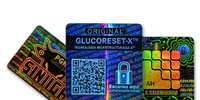
But the part that has genuinely changed the game is what happens when holography meets digital tracking. Leading holographic packaging suppliers now produce labels that carry unique characteristics easily identifiable to the eye. Serialized QR codes, 2D Data Matrix barcodes, and RFID substrates within the holographic layer. A single label can deliver visual authentication, tamper evidence, and a unique scannable identifier simultaneously, which can tie the physical package to a live digital supply chain record.
The Regulatory Context
This is, in fact, the same architecture that the Drug Supply Chain Security Act (DSCSA) has been demanding all along, which was fully enforced in 2025. Under DSCSA, every prescription drug unit sold in the United States is required to have a unique product identified. This includes a National Drug Code, serial number, lot number, and expiry date in a format that allows electronic verification at each point of custody transfer.
Globally, over 78 countries now mandate pharmaceutical serialization in some form. The EU Falsified Medicines Directive imposes equivalent requirements across Europe. For multinational pharmaceutical companies navigating this landscape, a well-chosen holographic sticker manufacturer is not a packaging vendor, but a compliance partner.
The market has responded exceedingly well to this. Today, with pharmaceutical anti-tampering mandates and serialization requirements as the primary growth engines, the global security holograms market is projected to reach $9 billion by 2035, after it reached $4.7 billion in 2025.
What to Look For in a Holographic Partner
Not all hologram stickers for sale are engineered to the standard that pharmaceutical applications demand. When evaluating holographic security partners, several criteria separate tier-one suppliers from commodity providers.
A supplier’s design origination process must operate under protocols that make illegal replication impossible. Proprietary designs created for one client should and must remain proprietary. Origination security, therefore, is the most critical factor here.
Equally essential is integration capability. Holograms that cannot interface with existing ERP and serialization systems are security features in isolation, not security features in context. The right supplier understands the compliance infrastructure and designs labels that plug into it.
Custom covert features like microtext, UV-reactive elements, nano-scale features readable only with specialized equipment add a forensic verification layer that is invisible to counterfeiters. These are the last-resort authentication tools activated when a product’s legitimacy is formally contested.
And quality at scale cannot be an afterthought. Pharmaceutical supply chains operate at volumes where label variance is not a minor inconvenience — it is a security gap.
The Larger Picture
It would be a mistake to frame holographic labeling purely as a compliance exercise. The business case runs considerably deeper.
Brand equity is at stake in ways that are difficult to quantify until a crisis arrives. A single high-profile counterfeiting incident (one that exposes a manufacturer’s inability to authenticate its own product) can cause reputational damage worth multiples of an entire authentication program’s cost. Holographic security is, among other things, a defence against that scenario.
Market access is equally in play, as serialization and holographic authentication become import requirements in more regulated markets, the absence of compliant packaging stops being a compliance gap and starts being a revenue gap.
Additionally, a supply chain intelligence dimension exists that commonly goes underrecognized. When every unit in the distribution network carries a scannable, serialized holographic identifier, the resulting data is not merely a regulatory record but a real-time map of product movement. Diversion routes become visible. For the first time, the supply chain looks genuinely legible and not blurry.
The Direction of Travel
The industry’s trajectory points toward what analysts are calling “phygital” authentication — hybrid systems in which a single physical label simultaneously delivers visual verification, electronic authentication, and a blockchain-anchored custody record. By the early 2030s, holograms embedded with QR-secure codes and linked to distributed ledger records will be the standard architecture, not the frontier.
The implication for pharmaceutical manufacturers is straightforward: the time to build these capabilities is now, not after the regulatory environment makes it mandatory. The companies investing today in sophisticated holographic security programs — working with leading hologram label manufacturers and holographic packaging suppliers who understand both the optics and the compliance architecture — will be better positioned operationally, regulatorily, and competitively than those who treat authentication as a checkbox.
One final point worth making: there is something genuinely important about a security technology that ordinary people can use. A pharmacist in a rural clinic, a nurse checking a shipment, a patient inspecting their prescription can all look at a holographic label and make an immediate, meaningful judgment about whether a product is genuine. No scanner required. No database lookup. No specialist.
That accessibility is not a secondary feature. In a supply chain as long and as complex as pharmaceutical distribution, the most valuable verification layers are the ones that work everywhere, for everyone, without friction. Security holograms do that at Holoaegix. And at a moment when the cost of getting it wrong is measured in human lives, that is not a small thing.